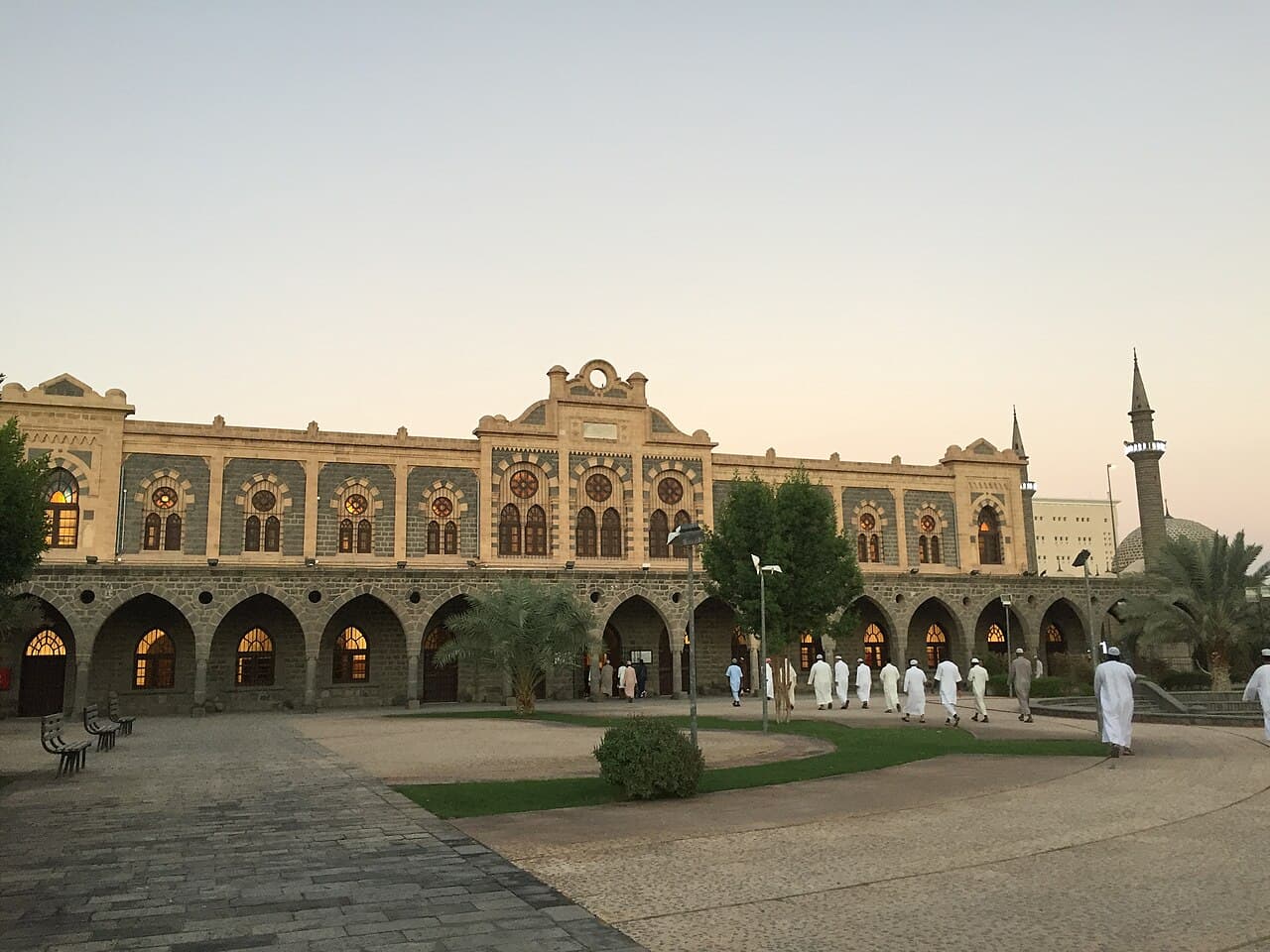
Madinah now has two railway stories that should never be collapsed into one. The modern Haramain High Speed Railway carries passengers through a live national system. The former Hijaz Railway terminus in Anbariya is a historic complex converted into a museum. The contrast explains how arrival infrastructure can move from working edge to protected city memory.
This feature follows the old station's changing function rather than giving a travel itinerary. Historical dates and building facts come from official pages; conclusions about infrastructure, memory and urban position are editorial interpretation.
At a glance
Start here
- The Hijaz terminus opened in 1908 as the final station of a long-distance railway.
- Its service buildings made it an operational complex, not only a ceremonial facade.
- Restoration and museum conversion created a new public role after railway use ended.
- The modern Haramain system represents a distinct transport era and location.
01
Arrival on a new time scale
Visit Madinah says the station opened in 1326 AH, corresponding to 1908, as the Hijaz Railway's final station. Its account contrasts a five-day train journey from Damascus with a much longer traditional journey. The precise comparison belongs to that official page; the larger point is that rail compressed distance and reorganized how people, goods and information approached Madinah.
A terminus is both an end and a transfer. Passengers had to move from the railway into the city, while staff managed rolling stock, supplies and service buildings. That operational threshold is the right scale for understanding Anbariya: not a single picturesque object, but a transport system meeting the city and changing the experience of arrival.
Sources: Visit Madinah, Madinah Region Development Authority; Haramain High Speed Railway02
Twelve buildings, not one facade
The official museum page describes twelve buildings that served the railway within a large station site. That matters more than an isolated architectural style label. Different activities required different spaces, and their arrangement reveals the practical logic of a terminus. A museum visit becomes richer when you ask what each building enabled rather than collecting exterior photographs.
Look for thresholds, yards, routes and sightlines. Where could passengers gather? How might rolling stock be serviced? Which buildings address the track side and which address the city? The page does not answer every functional question, so keep these as prompts rather than facts. The surviving complex invites investigation without authorizing invented certainty.
- Read the site plan before decoration.
- Distinguish passenger space from service space where labels allow.
- Leave unidentified buildings unidentified.
03
A site with deeper layers
Al-Suqya Mosque stands within the old station walls, but its story predates the railway. Its official page connects the place to the Prophet's journey toward Badr and says the structure was rebuilt several times on an earlier footprint. The museum page also notes the mosque and nearby well in its account of the complex.
This overlap corrects a simple progress narrative in which the railway arrived on empty land. Infrastructure entered a landscape already carrying religious and local memory. Treat the station boundary as a later layer around an older place, while avoiding devotional instruction or unsourced claims about present access to the mosque, well or museum grounds.
Sources: Visit Madinah, Madinah Region Development Authority; Visit Madinah, Madinah Region Development Authority04
Closure and a second life
The destination page says station operation became intermittent during the First World War and had ended by 1921. It later underwent restoration and rehabilitation before becoming a historical and archaeological museum. Conversion preserved the railway setting while changing its users, rhythms and purpose. The date of museum establishment belongs to a different chapter from the railway's opening.
Museum use does more than save a facade. Galleries now extend from pre-Islamic Madinah to the modern era, while inscriptions, manuscripts and railway material place transport inside a longer city story. The terminus has therefore become a place where arrival itself is interpreted, and where the city's chronology is wider than the operating life of one railway.
Sources: Visit Madinah, Madinah Region Development Authority05
Compare old and new rail systems
Saudi Arabia Railways describes today's Haramain High Speed Railway as an electric network connecting Madinah with Makkah and intermediate stations. Its passenger portal is a live service environment organized around dates, seats, assistance, baggage and station facilities. The old Hijaz terminus is no longer part of that passenger operation, even though both stories concern railway arrival.
The contrast is productive. One site displays physical residue of an earlier railway and its museum afterlife; the other manages contemporary movement. Do not tell a driver to go to the railway museum when you mean the Haramain station, and do not describe the museum as the current terminus. Historical clarity has an immediate logistical benefit.
Sources: Haramain High Speed Railway; Haramain High Speed Railway; Visit Madinah, Madinah Region Development Authority06
Read the museum with three questions
At the museum, ask what the railway changed, what physical evidence remains, and how conversion reframed it. Use labels to separate original railway material from later adaptation. Connect the station to Anbariya and the nearby mosque without assuming every visible feature belongs to 1908. When a carriage has a later use, record both layers rather than choosing one.
Current opening, admission and programme details are mutable even when a destination page lists them. Verify them before setting out. The enduring value lies in the documented chronology and form: a working terminus became an interrupted system, then a restored place for interpreting Madinah's past.
Sources: Visit Madinah, Madinah Region Development Authority; Visit Madinah, Madinah Region Development Authority; Haramain High Speed RailwayUseful answers
Reader questions
Is the Hijaz Railway Museum Madinah's current station?
No. It occupies the former Hijaz terminus in Anbariya. Current Haramain passenger services use the modern HHR system and a different station.
Sources: Visit Madinah, Madinah Region Development Authority; Haramain High Speed RailwayWhen did the historic terminus open?
Visit Madinah dates its opening to 1326 AH, corresponding to 1908, and describes it as the Hijaz Railway's final station.
Sources: Visit Madinah, Madinah Region Development AuthorityWhy is Al-Suqya Mosque part of the station story?
It stands within the station walls but has an earlier site history, showing that railway infrastructure entered a landscape with pre-existing memory.
Sources: Visit Madinah, Madinah Region Development Authority; Visit Madinah, Madinah Region Development AuthorityDoes this article confirm current museum hours?
No. Check current official information before visiting. The historical interpretation does not depend on reproducing a schedule that may change.
Sources: Visit Madinah, Madinah Region Development AuthorityRead the evidence
Sources and further reading
These sources support the relevant sections above. Plans and comparisons are editorial suggestions. Check operators for current arrangements.
- Hijaz Railway Museum ↗Visit Madinah, Madinah Region Development Authority · Accessed 14 September 2026
Opening, terminus role, buildings, interruption, closure, restoration and collections.
- Al-Suqya Mosque ↗Visit Madinah, Madinah Region Development Authority · Accessed 14 September 2026
Earlier site history, rebuilding and architectural context within the station area.
- Haramain High Speed Railway | Makkah to Madinah Train Tickets ↗Haramain High Speed Railway · Accessed 14 September 2026
Evidence of a live passenger system with timetable, booking and service tools.
- Station services ↗Haramain High Speed Railway · Accessed 14 September 2026
Present-day railway station services and passenger operations, used to distinguish the modern system from the museum.